

News


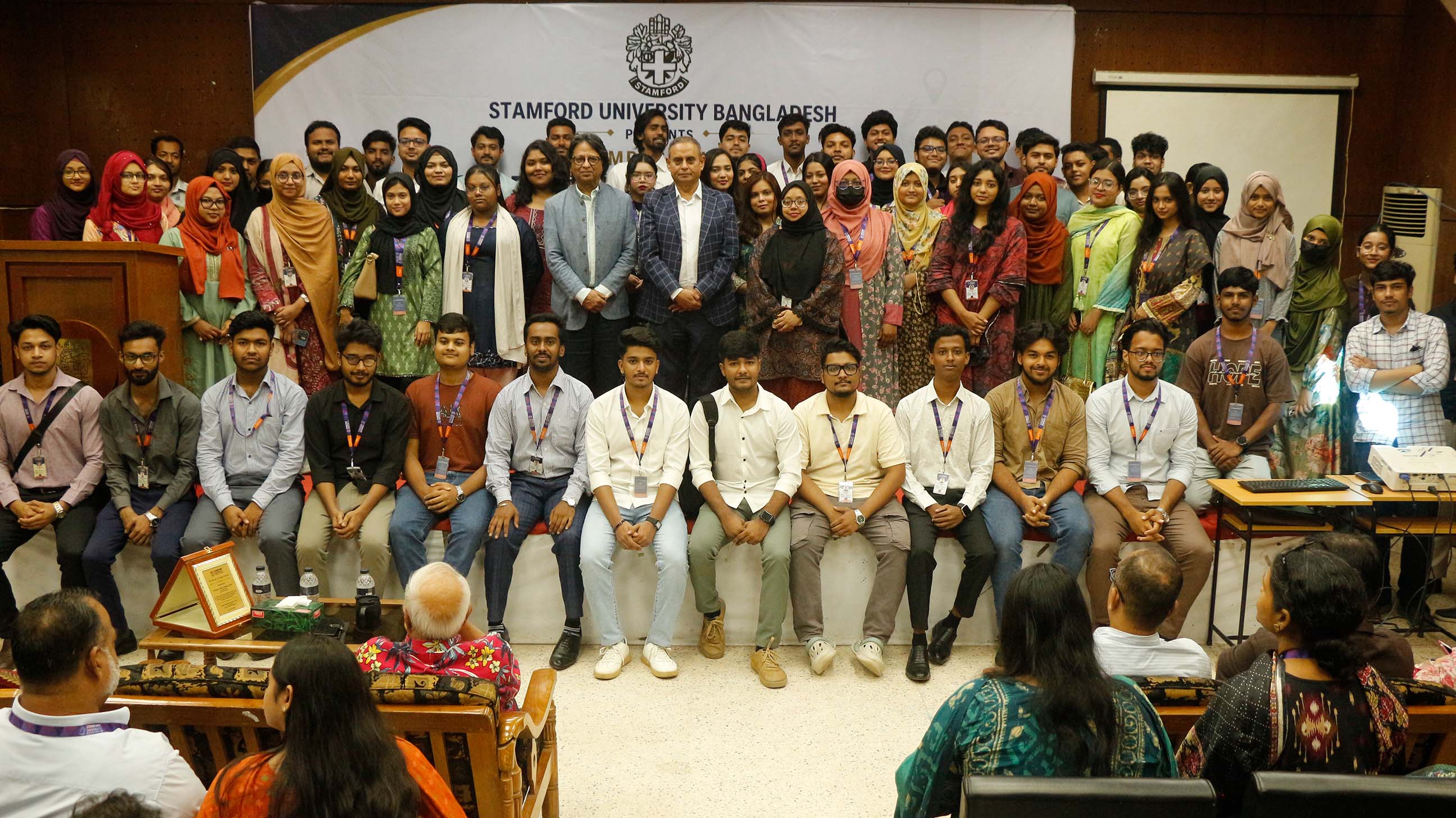
Stamford University Bangladesh has launched a new high-profile academic symposium series titled “Looking Ahead by Looking Back,” designed to explore contemporary challenges and emerging trends through a critical examination of their historical, theoretical, and practical foundations.
The inaugural symposium of the series, focusing on “Supply Chain Management,” featured Prof. Dr. Shams Rahman, Honorable Vice Chancellor of East West University, as the keynote speaker. The symposium was formally launched by Prof. Dr. Sharif Nafe As-Saber, Honorable Vice Chancellor of Stamford University Bangladesh, marking an important addition to the university’s academic and intellectual activities.
The theme of the symposium was particularly relevant in an era when supply chains have become central to global business competitiveness, economic resilience, technological transformation, and sustainable development. From the early division of labor to highly interconnected global supply networks, the evolution of supply chain management reflects some of the most significant transformations in economic and industrial organization.
In his keynote presentation, Prof. Dr. Shams Rahman traced the evolution of supply chain management from the foundational ideas of Adam Smith to the complexities of the Fourth Industrial Revolution (Industry 4.0). He began with Smith’s celebrated discussion of the pin-making process in The Wealth of Nations (1776), which demonstrated how the division of labor and specialization could dramatically enhance productivity. This historical starting point provided an insightful foundation for understanding how production systems have progressively evolved toward increasingly sophisticated forms of coordination and integration.
The discussion then moved through major milestones in industrial development, including the emergence of the assembly line, mass production, operations management, logistics, and modern supply chain systems. The evolution illustrates a fundamental shift from managing individual production activities toward managing the interconnected flow of materials, information, finances, technology, and relationships across entire value networks.
Prof. Rahman also connected these historical developments with contemporary management theories and practices. He highlighted the theoretical foundations underlying supply chain management while examining how these concepts have translated into practical approaches to production, distribution, inventory management, procurement, transportation, and organizational coordination.
A significant part of the presentation focused on the transformation brought about by technological advancement. The emergence of automation, digital platforms, data analytics, artificial intelligence, the Internet of Things (IoT), robotics, and other Industry 4.0 technologies is fundamentally reshaping the way organizations design and manage supply chains. These technologies are enabling greater visibility, speed, flexibility, predictive capability, and real-time decision-making, while simultaneously creating new managerial challenges.
The keynote also explored the increasingly disruptive nature of management and technology. In an environment characterized by geopolitical uncertainty, pandemics, climate-related disruptions, changing consumer expectations, and rapid technological innovation, supply chain managers are required to move beyond traditional efficiency-oriented approaches and develop systems that are more resilient, agile, adaptive, and sustainable.
One of the most engaging aspects of the symposium was the way Prof. Rahman connected historical perspectives with contemporary management challenges. By looking back at the intellectual and industrial origins of supply chain thinking, participants were encouraged to better understand where current practices came from—and, more importantly, how those lessons can inform the future.
The presentation generated considerable interest among the participants and was followed by a robust and intellectually stimulating question-and-answer session. Faculty members, students, and other participants actively engaged with the speaker, raising questions concerning technology, industrial transformation, management practices, resilience, and the future direction of supply chain management.
The symposium was both thought-provoking and intellectually enriching, offering participants an opportunity to connect classical economic thought with modern management theory and the rapidly changing technological landscape. The discussion demonstrated that understanding the future of management requires not only an appreciation of emerging technologies but also a deeper understanding of the historical forces, theories, and managerial practices that have shaped the present.
The launch of “Looking Ahead by Looking Back” therefore represents a significant academic initiative by Stamford University Bangladesh. By bringing distinguished scholars and practitioners into dialogue around major contemporary issues while grounding those discussions in historical and theoretical perspectives, the series has the potential to contribute meaningfully to intellectual discourse among students, academics, and professionals.
The inaugural symposium on Supply Chain Management set a strong precedent for the series, demonstrating the value of interdisciplinary reflection, critical inquiry, and dialogue between theory and practice. As organizations and societies navigate an increasingly uncertain and technologically driven future, the ability to learn from the past while anticipating what lies ahead will remain essential.